
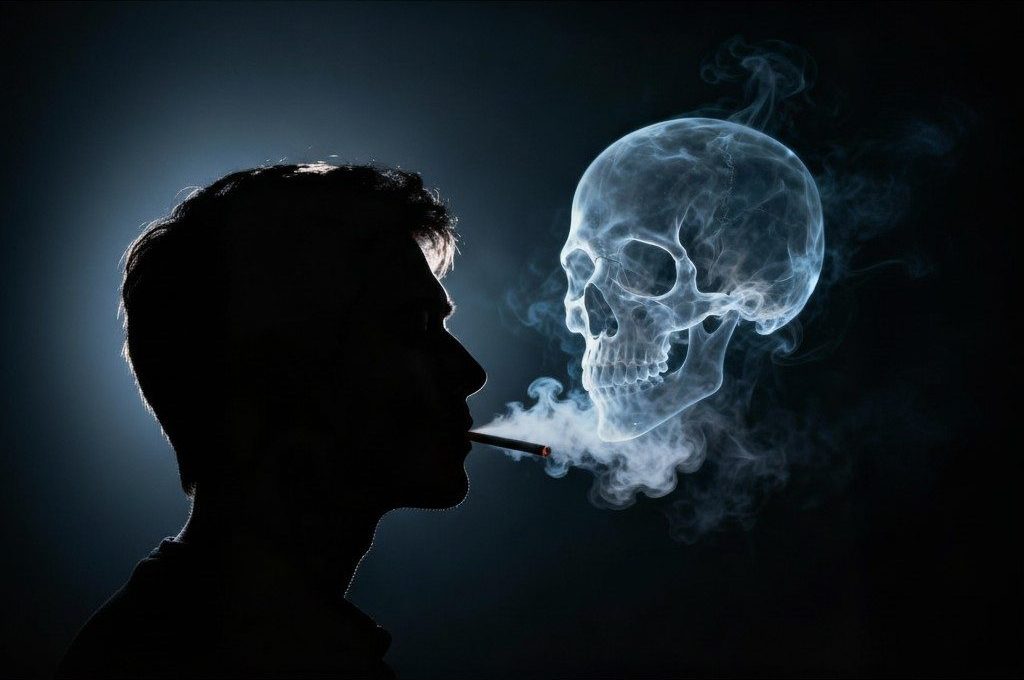
Each puff begins like a breath of calm,
Inhale the storm, exhale the qualm,
Breathing was meant to heal, not fray,
And when smoke crept in, we turn into prey.
A borrowed peace in a fleeting trance,
A whispered pause, a smoky stance,
The ember burns, the craving grows,
Each puff, a promise the body owes.
But the truth lies deep in every breath,
Where calm entwines with silent death,
For one breath heals, the other decays,
One gives you life, the other takes it away.
The Illusion of Calm
For some, smoking feels like therapy in disguise, a steady inhale, a slow exhale, and a few quiet moments with oneself. It mirrors the mindfulness of a breathing exercise, offering comfort in the middle of chaos. But behind that calm lies an illusion, one that comforts the mind while quietly harming the body.
The Social Trap and Stark Reality
College or workplace peers might make smoking look cool, a casual puff shared over conversation can give them a sense of belonging, but the reality is stark,cigarettes manhandle nearly 40 crore Indians, a number as staggering as it is alarming. Out of curiosity, anyone might be tempted to try just one, what might seem nearly harmless at the moment can put you caged in no time. Research states that nearly 61% of people who try a single cigarette eventually become daily smokers, at least for a while.
The glow of a smouldering cigarette may seem alluring, but look beyond the smoked mirrors, it hides a slow suffocation that might soon consume your breath away. A chest X-ray twenty years down the lane screams death while most of us are still trapped in an illusion of finding a moment of peace. Smoking is no more just a habit; it’s the leading cause of early deaths among men and ranks among the top ten causes of death in women.
Children Caught in the Smoke
The rising acculturation and hero worshipping amid the upheavals of mainstream media has led 8.5% of kids between the ages of 13-15 to pick up cigarettes just as casually as they would unwrap a candy. In India, 11.4% of children spark their first cigarette before they’ve blown out seven candles on their birthday cake. A flame that should mark a wish has eventually now marked the beginning of a habit.
Adults: From Curiosity to Coping
While children are just starting to fall into this snare, adults remain lost in a vicious loop of smoke and solace, chasing calm through clouds that only deepen the haze.
India ranks as the second-largest country addicted to tobacco, which is the third most commonly abused substance after caffeine and alcohol. For many above 30, the habit no longer begins with curiosity but with coping. A cigarette becomes their way of breathing through the stressful life. The sense of relaxation that follows each puff isn’t just emotional. Nicotine momentarily alters brain activity, giving a surge of dopamine and tricking the mind into believing it’s found relief with a sense of high. In reality, the calm that feels earned is merely borrowed, a fleeting escape that soon demands to be repeated. What begins as a coping mechanism slowly reshapes into dependence, binding both body and mind to a cycle of craving and release.
The Real Culprit: Tar and Its Devastation
While most of us have heard of nicotine, the real culprit behind many of smoking’s deadly consequences is tar — a thick, toxic residue that coats the lungs. Its inhalation can lead to cancer, COPD, heart disease, stroke, erectile dysfunction, infertility, cataracts, infections, and even insomnia. The list is long, but the breath it steals is longer. Every puff of smoke wreaks havoc on not just your lungs; it damages every system it touches.
Despite these damages, smoking weakens the lung’s immunity, making it easier for viruses like COVID-19 to invade, destroy, and even succumb them to death, which clearly conveys that smokers did not have a good outlook during the pandemic.
A Surgeon’s Warning: When Lies Cost Lives
While graphs and numbers show only a part of the story, the true significance struck me when I interviewed a surgeon, who revealed the full picture of the current state of smokers. He discussed a case where a patient lied about his smoking status before the surgery, while right after the surgery, his lungs were filled with fluid (acute pulmonary edema) and he teetered on the brink of death. Fortunately, he was revived back to life by doctors through immediate medical interventions, but not everybody driving themselves into the nicotine graveyard will always find their way back. Every cigarette is a gamble with your life; it steals time, health, and life, and the cost of hiding a habit can be far greater than you imagine because nicotine doesn’t forgive; it only punishes in ways numbers can’t show.
Ground Reality: Inside Beedi Colony
To grasp the gravity of the issue, I visited Beedi Colony in Kengeri, Bangalore, named after the ancestral occupation of rolling cigarettes. Today, the colony exposes a large number of teens to tobacco and other substances, with easy access to beedis, smokeless tobacco, nicotine, cannabis, inhalants like whiteners, kerosene, and even snorting coke. While their family’s occupation serves as a major factor in developing such habits, low socio-economic status, limited access to education and employment opportunities, and peer pressure also play significant roles.
Beedi Colony is far from the only place where young lives are being quietly consumed by tobacco. Across India, thousands of similar communities remain hidden, where easy access to beedis and other substances slowly steals the health and breath of the youth. These are lives gasping away in silence, trapped in cycles of addiction before they’ve even had a chance to fully live.
The Ruthless Grip of Addiction
After speaking with nicotine addicts, I began to understand just how hard it is to break free. I witnessed hospitalized patients going so far as to bribe security guards for a single cigarette. The grip of nicotine is ruthless; it can spark sudden rage and even negate the effects of strong sleep medications, making even the simplest decisions feel impossible. Addiction doesn’t emerge from nowhere: it can be fuelled by strict parenting, school pressures, peer influence, and even the glamorization of smoking by actors and social media personalities. What seems like a habit often becomes a relentless cycle, pulling the body and mind into its grasp.
Why Quitting Feels Impossible
It is easier to live with cigarettes and considerately harder to quit because:
- The dopamine surge: Nicotine makes the brain release dopamine, which creates pleasure and relief from stress. The brain “craves” that feeling again and again.
- Habit and triggers: Smoking often gets linked to daily activities—like morning tea, after meals, or during stress.
- Withdrawal symptoms: Irritability, restlessness, cravings, poor concentration, and anxiety make it tough to stay off.
- Social environment: Influence from friends or colleagues who smoke makes it harder to quit.
The Right Way to Quit
Sudden quitting is rarely effective and can be physically and mentally overwhelming. The best approach is to gradually reduce both the frequency and intensity of smoking. Treat quitting as a process rather than a single-day event; each step forward counts. Start by identifying your triggers, then replace some cigarettes with healthier alternatives like deep breathing, water, or short walks. Over time, your cravings will lessen, and your body will begin to recover. Patience and persistence are key — quitting is a journey, not an instant fix.
Willpower meets treatment
Always remember discipline is the foundation: A person has to want to quit; without that, the doctor’s arsenal filled with medicines alone won’t make up for it.
• Drugs help, but don’t replace willpower.
• Nicotine patches/gums/lozenges reduce withdrawal symptoms and help in harm reduction in the short term.
• Medicines like bupropion (reduces cravings) and varenicline (blocks nicotine’s “pleasure effect”) almost double the chances of successful quitting.• Best results happen when motivation + family support + medications + counselling are combined.
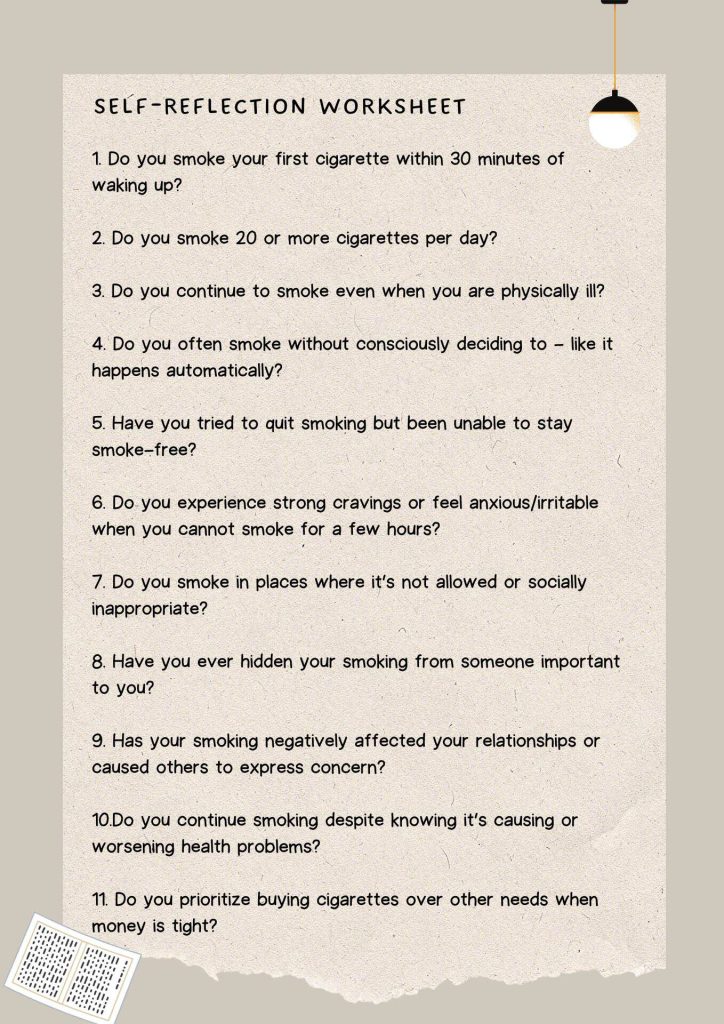
Self reflection worksheet
Here’s a brief self assessment designed for readers to understand and reflect on their relationship with smoking.
How to Quit Smoking: Your 7-Step Action Plan
Here’s a step-by-step guide to quit:
1. Set a quit date → Choose a realistic day in the next 2–4 weeks.
2. Prepare → Remove cigarettes, lighters, and ashtrays from your home and car. Tell family/friends for support.
3. Know your triggers → Identify times you usually smoke (stress, tea breaks, after meals) and plan alternatives (deep breaths, water, short walk, chewing gum).
4. Use aids if needed → Nicotine replacement therapy (patches, gums, lozenges, sprays) or prescription medicines like bupropion or varenicline.
5. Manage withdrawal → Expect cravings and mood swings for the first 2–4 weeks; these get better with time.
6. Stay busy and active → Exercise, hobbies, yoga, or mindfulness help reduce cravings. 7. Relapse is common → Don’t give up if you slip. Most people need 3–4 attempts before they quit for good.
7. Relapse is common → Don’t give up if you slip. Most people need 3–4 attempts before they quit for good.
Will my body Recovery After Quitting Smoking
Yes—many changes can improve or even reverse once a person quits:
And if you’re wondering if quitting can make a difference to the already caused damage, here’s how your body copes up and starts the reversal mechanism:
• Within 20 minutes: Heart rate and blood pressure start to drop.
• Within a few weeks: Breathing and circulation improve; coughing decreases.
• After 1 year: Risk of heart disease drops to about half of a smoker’s risk.
• After 10 years: Risk of lung cancer falls significantly, though not to the level of a non-smoker. • Other benefits: Sense of taste and smell return, skin and teeth improve, fertility improves, and the overall immune system gets stronger.
The Tobacco Industry’s Hidden Tactics
The global nicotine industry is worth 1 lakh crore, capitalising on the reward centre of the human brain. The nicotine industry’s never-ending rampage has already claimed 16.6 crore lives across the globe (from 2000 to 2025). 1.4 crore of the Indians are willing to quit smoking in 2025.
Masquerading nicotine products by flavours and disguising them as kesar or infusions with mint to give the cooling effect or infusing flavours like honeydew in cigarettes makes it harder for people to quit. Industry’s practices are immoral, if not illegal yet. Nicotine products have been glamourised under the disguise of Vape (E-cigarettes), Hookah (waterpipe/sheesha) attracting massive crowds. Oral nicotine products consumed by relatively lower socioeconomic people are Khaini (mixture of tobacco and slaked lime), Gutka (has beetle nut, tobacco, and other flavourings), Zarda (fragrant form of chewing tobacco with spices), Pan masala (free from nicotine, but has cancer-causing Areca nut).
NGOs and political leaders need to put a light on the issue and take appropriate measures before tobacco consumes the world. Some of the measures recommended by WHO are:
- Measures to ban flavours and additives that make these products more appealing
- Complete bans on tobacco advertising, promotion, and sponsorship, including on digital platforms; and
- Regulation of the design of the products and their packages to make them less appealing.
From First Puff to Freedom: Your Final Wake-Up Call
Smoking begins with a breath, one that feels like calm, like control. Yet that breath carries a hidden price, slowly tightening its grip on the lungs, the heart, the mind making it a self-inflicted lifelong death sentence where each puff tightens up the noose around your neck. Every smoky draw writes a promise the lungs can’t keep. Cigarettes offer relief, but only in the way a storm offers silence, right before it breaks.
From the bustling Beedi Colony in Kengeri to homes across the city, lives are quietly caught in this cycle. From the first curious puff to years of dependence, time shall slip away from your hands. And if you still call it a slow poison, medical professionals call it a rapid assassin for the enormous damage it can cause. Each statistic, millions addicted, thousands lost to disease, represents a story interrupted. But freedom from this irresistable compulsion is still in your very hands. While many just see it as a step, quitting is remarkably a journey, each step, reclaiming of air, of health, of life itself. Every breath you take doesn’t have to be borrowed from smoke; it can be yours again, clean, full, and alive.
Quitting isn’t about giving something up; it’s about giving yourself back.
Because the real high isn’t nicotine, it’s the rush of waking up one day and realising your breath belongs to you again.